Monday, August 20, 2012

A Summer Spent Fishing at JBH

My name is Taylor Brewer and today is my last day as a STEP student. I currently am going to WSUV to get my bachelor’s in biology.  I then hope to further my education at a more fisheries focused school, possibly UW or OSU.  I have known I wanted to be in the fisheries field since I was very young.  My dad started me off fishing when I was two and since then I have loved it.  As a kid all my friends wanted to be policemen, fire fighters, and doctors, while I wanted to be a fish hatchery worker.

Taylor then

This summer was one of my favorite summers ever. When I came into this STEP position I did not know what to expect. On my first field day I was amazed at the work I would be doing all summer in some of the most beautiful habitats. Most mornings I started off gearing up in my waders and canoeing to one of our sites. When we arrived we would conduct habitat surveys to determine if each sites habitat was suitable for salmon. We would then pull 4-5 seine nets to get a fish community sample. We caught a wide variety of fish including threespine stickleback, Chinook, suckers, and peamouth, to name a few.  One time we even had a large (~2 ft) common carp in our net. I also saw some amazing wildlife such as coyotes, elk, raccoons and so much more.


Taylor now

Before I started I had high expectations for this position and it by far exceeded them. I had a chance to meet a variety of people such as Donna Allard, Sam Lohr, and of course Jeff Johnson. They all taught me different things. Donna taught me how to love Lily pads (and big trucks).  Jeff taught me to always have two of everything.  Especially scales when it is extremely windy out.  Sam taught me the identification of many species of spiders, and one time in the excitement of trying to see one he flipped his kayak over.  They also taught me many things that will be useful for me in the future, like surveying habitat, deploying temperature loggers, and even the basics on pit tag array systems.  After staying on the refuge all summer I still am surprised how each slough, having their own minor differences, can be so diverse in their fish and wildlife community.

Submitted by Taylor Brewer  

Tuesday, July 31, 2012

I used to Like Lily Pads or Things my Mother Taught Me.

I spent the last two weeks working at Julia Butler Hansen National Wildlife Refuge with Taylor and Hannah.  I’d worked with Taylor before but never with Hannah.  I soon learned that she was yet another of the exceptional STEP “kids” that we have working with us this summer.
It was another typical morning.  Slightly overcast and a bit cool.  Perfect for catching fish.  We decided to finish the last site in Winter Slough.  We did not catch anything exciting.  Just the usual northern pikeminnow, some sunfish, a few sculpin, and three spined sticklebacks.  We catch very few salmon in these sloughs at this time of year with temperatures nearing 20°C. 
After loading up the gear in the truck, we decided to see if we could drive to the upper sites in Indian Jack.  While driving on Center Road through the refuge, Hannah called out that she spotted “the tree” at the upper site.  We drove through the field and sure enough, we were at the site.  That eliminated at least an hour of rowing. 
We unloaded our gear and pulled four seines.  We did get a few carp but not much else.  We collected our water quality and habitat measurements.  Since we were very close to the middle site, we figured we might as well row the five minutes down to the site.  They told me it was covered in lily pads and not an easy site to seine. 
Sure enough, as we neared the site, the channel became fully covered in the vegetation.  It was a chore to row through them.  As we rowed and rowed, not making much progress, Hannah told me that she used to like lily pads.  I laughed.  I asked her how we could seine at the site.  She pointed towards a tree on the bank and said there was an area of open water underneath it.  Not a whole lot of area, just enough to get the seine in and do a small loop. 
Indian Jack Site #9 Covered with Lily Pads
We began by collecting our water quality and habitat measurements.  I grabbed the YSI, an instrument used to measure the dissolved oxygen and temperature.  I pressed the power button and nothing happened.  I tried holding down the button.  Nothing.  I handed it to Taylor who came up with the same conclusion.  Dead Batteries.
Well, we had no batteries with us and none of us really wanted to row back through the lily pads to the truck.  Taylor and Hannah thought then that we could swap out the batteries from the PIT tag detector.  After opening up the unit we saw that the batteries were different.  Now what?  Taylor remembered his mother telling him once that if you had dead batteries you could rub them in your shirt and it would reenergize them. 
Hannah and I watched as Taylor did just that.  After a few minutes he put the batteries back into the unit.  He pushed the power button, smiled and told Hannah to quickly put the probe in the water.  Yes, it worked.  Thanks Taylor’s Mom! 
I’m sure you are all wondering what we caught at that site.  Nothing, but we sure did have fun.  And we now know what to do if we need just a bit more battery juice.

Submitted by Donna Allard

Friday, June 29, 2012

A gorgeous day at the office!

Usually, a day at the office for me entails sitting at my computer, typing away on planning documents and reports.  I occasionally see a bird or two flutter past my window, and I am lucky enough to get real sunlight every day (well, in the summer, that is).  But yesterday, I was able to visit the office that other fish biologists get to call their own every day - and it was gorgeous!

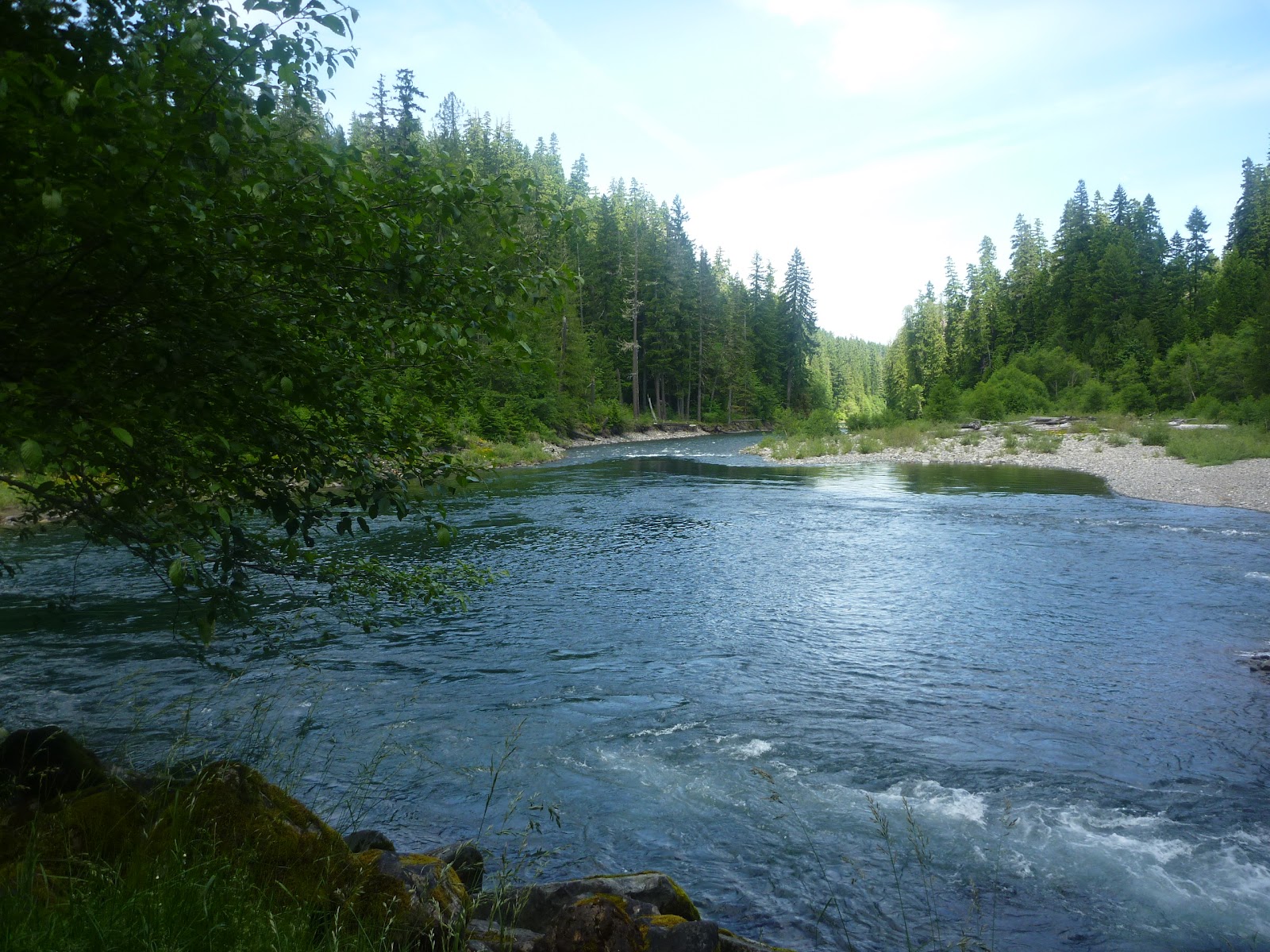
The Clackamas River, Oregon (M. Koski, USFWS)
The Fish and Wildlife Service, and other agencies like the Oregon Department of Fish and Game and the US Forest Service, have a great many people who spend the majority of their working hours outside for their various research and conservation projects.  Yesterday I tagged along with some of them to watch bull trout being released into the Clackamas as part of a multi-year project to reintroduce this threatened species back into habitat they historically occupied.  These are very special fish that were collected from Lake Billy Chinook, implanted with radio-tags, trucked over to the upper basin of the Clackamas River, and will hopefully reproduce and re-establish a self-sustaining bull trout population.  Last summer was the first time the Clackamas had seen bull trout since 1963, and since many of the problems that caused their disappearance from the river are now mitigated, the Clackamas is a suitable home for bull trout once again.

Doesn't this Clackamas tributary look like excellent bull trout spawning and rearing habitat?  Why, yes it does!  The water here is COLD, CLEAR, COMPLEX (i.e., lots of woody debris and cover), and CONNECTED.  Those are the 4 C's that bull trout need! (M. Koski, USFWS)

Planning for this project started in about 2004, and I've been involved in the planning efforts for almost three years now.  My work has focused primarily on helping to define and shape the monitoring and evaluation program, and provide technical assistance when needed.  When bull trout finally went into the river last year, there were a lot of really happy people that were able to start seeing their hard work pay off!  And yesterday, although I didn't do the difficult tasks of chasing down the fish and trucking them over, I was able to actually put one of those bull trout in the river myself.  Woo hoo!

Patrick Barry (ODFW) and Brad Goehring (USFS) pick out a nice subadult bull trout for me from the transport truck (C. Allen, USFWS).
Good luck, bull trout!  I hope that you like your new home! (C. Allen, USFWS)
You might notice that there are a couple of people filming off to the side.  They are from Freshwaters Illustrated, and have worked with the Service on a number of other projects, currently producing a short film about Pacific lamprey conservation.  So who knows...perhaps we'll get to see some more really cool bull trout reintroduction footage in the future!

If you want to learn more about the Clackamas bull trout reintroduction project, please visit the project's website here.  You can read more about why this project was initiated, how it will benefit the recovery of bull trout, and how we are safeguarding the other listed fish in the Clackamas with our monitoring program.  There's even a short video of bull trout spawning from our very first year of the reintroduction!

Thursday, June 14, 2012

Students for the Summer

Although the weather does not seem like summer, the number of students working in our office tells me otherwise.  A total of 13 students have been hired for local field work. Eight have been hired to work out of Walla Walla and will probably not step foot in this office, at least this summer.   Not all of the students have started but each day seems to bring new faces into the office.  I was happy to work with a few of the students so far.  I'm sure I will be getting to know more of them as the weeks go by.  They are enthusiastic, smart, fun, and ready to learn more.  Here are a couple of pictures of their work. 

Sean and Taylor worked a week together at Julia Butler Hansen National Wildlife Refuge (JBH).  This work is part of a bigger multi-agency project titled "Multi-Scale Salmon Ecosystem Action Effectiveness Research in the Lower Columbia River and Estuary".  Part of the work at JBH is to evaluate the effects of tide gate replacements on the refuge.  We accomplish this by sampling various sites with a seine to determine monthly fish community composition and distinguish between native and non-native fishes.  Taylor will spend most if not all of the summer at JBH, while Sean will be part of lamprey research team.

Pulling out a seine with a kayak.
Taylor and Sean sampling fish.

One week I travelled to Bandon Marsh National Wildlife Refuge to continue the post-restoration monitoring work (http://www.fish-notes.blogspot.com/2012/05/bandon-marsh-restoration-and-legend-of.html).  There Brook and I worked with Sean and Juliet.  It was great having two more people to help carry all the gear out to the sites.  We also split up for awhile to get the work done more quickly.

Brook and Juliet removing fish from a fyke net.
 
Sean and Juliet sampling fish.
I am looking forward to meeting and working with some of the other students who will be joining our office for the summer.  Hopefully, you will meet them too, through their own blogs.

Submitted by Donna Allard
      

Thursday, May 17, 2012

Cargo for Conservation

Many years ago, I drove down to Ashland, Oregon, home to the U.S. Fish and Wildlife Service’s Forensic Laboratory.   It is the only lab in the world dedicated to crimes against wildlife.  As in police labs, forensic scientists examine, identify, and compare evidence using a variety of scientific procedures and instruments, in the attempt to link suspect, victim, and crime scene with physical evidence.
At the time, the lab also had a large warehouse containing row upon row of shelves containing a wide range of confiscated items.  Included were items made from ivory, coral, reptiles, furs, and bird feathers, to name a few.  The warehouse has since moved to Denver.   Most of the items ending up in the warehouse are usually seized at U.S. airports from people returning from travels abroad.  Some of these people are unaware that they are transporting illegal items back into the states and others are simply smugglers.    
The main purpose of my trip to Ashland was to gather an assortment of these items from the warehouse.  These items are now used in a conservation awareness program called “Cargo for Conservation”, a kit which shows and encourages species protection.   Educators studying endangered species can focus on the illegal wildlife trade as one reason many species are in trouble.
Items used for conservation awareness
I’ve used this kit on numerous occasions, at public events, in the classroom, or with groups of girl and boy scouts.  Highlighting the stories of the animals affected by illegal trade and allowing the students to actually see and hold those items made from the animals makes a dramatic impact.  This kit is available to all educators.  Please contact our office to reserve it.  
Submitted by Donna Allard
    

Wednesday, May 9, 2012

Bandon Marsh Restoration and the Legend of Face Rock

A couple of weeks ago, I went to Bandon Marsh National Wildlife Refuge to help Brook continue the post restoration monitoring work.  For the most part, the restoration work has been finished.  At least the earth moving part.  Tide gates have been removed and the dike is gone.  Fahys and Redd Creeks have been restored to their original channels.  Over 5 miles of new tidal channels have been dug.  Off the refuge, two fish barriers have been removed on Fahys Creek to allow salmon and trout full access to potential spawning and rearing habitat and into Fahys Lake.  Revegetation is still taking place in a few locations on the refuge.  More details on this marsh restoration project, the largest in Oregon, can be found at the following links.

Bandon Marsh National Wildlife Refuge
Bandon Marsh NWR Restoration - Video
Restoring Tidal Marshes on Oregon Coast National Wildlife Refuges - The Dish on Fish Blog


Fyke nets set in Redd Creek

We put out fyke nets, seined, and electrofished throughout the refuge to see what fish were using new and old sites.  We caught lots of really nice cutthroat trout, coho, starry flounder, as well as the usual three-spined stickleback and sculpin.  I was impressed when we caught coho yearlings and cutthroat trout in some of the very new channels, far from the creek.  I can't even begin to imagine the numbers and varieties of fish that may use these tidal channels in future years, but we'll be checking.

Brook sampling fish
A typical coastal cutthroat trout caught on the refuge

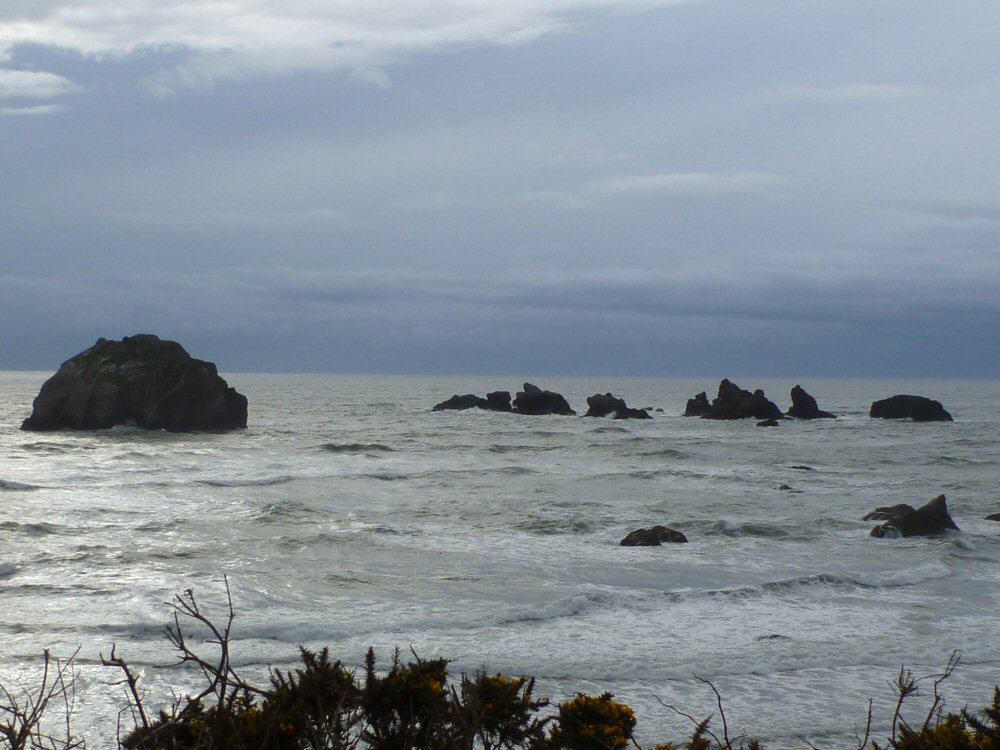
After one of our long hard days of carrying nets, buckets, and sampling gear through fields and mud, not to mention trying to beat the high tides, we had a chance to take a short ride to an ocean lookout.  There was a rock in the ocean, called Face Rock.  I saw the likeness to a woman's face right away. 

Face Rock
There are many variations of the legend of Face Rock but here is a short version from the Bandon's Visitor Guide.

"Legend from the Nah-So-Mah Tribe has it that the beautiful Indian princess Ewanua was visiting tribes on the coast with her father, Chief Siskiyou, and in celebration of their visit, a great potlatch took place.
The local tribes were in great fear of Seatka, the evil spirit of the ocean, but Ewanua and those in her tribe, who lived in the mountains, were not afraid.
After the feast, while others lay sleeping, Ewanua carried her dog, Komax, and her cat and kittens in a basket and wandered down to the ocean.
She danced and played with delight, and soon placed her pets in their basket on the beach and swam into the ocean, far from shore. Unaware of any danger, she was suddenly grabbed by a fearsome creature that came out of the water.
Komax, knowing his mistress was in danger, swam out to her with the basket in his mouth and bit Seatka. Howling with rage, the monster kicked off the dog and threw the cat and kittens far out to sea. He tried to get the princess to look at him, but she refused, knowing his power was in his eyes.
Now, the beautiful Ewanua lies in the ocean, looking skyward, refusing to look at Seatka, who sits nearby. Her beloved Komax and her cat and kittens lie to the west, waiting in vain for their mistress to arise."

Submitted by Donna Allard

Tuesday, May 1, 2012

Career Days at the CRFPO - 2012

The CRFPO held its 2nd annual 'open house' a couple of weeks ago. We renamed the event to career day, a term which better describes this program.  Two groups of high school students were invited this year on separate days to interact with some of our fish biologists.   This event was meant to showcase careers in science as well as with the U.S. Fish and Wildlife Service as a whole, and to give the students a closer look at some of the specific activities performed by our office.

Using electricity to capture lamprey.
This year there were four stations.  Each activity lasted about 1/2 hour, enough time to get our point across, but not too much time to let anyone get bored.  Not that they would, with all the cool stuff we had to show them. 

Anesthesiology 101 demonstrated the various ways we use electricity to either catch fish or put them to sleep so that we can tag them.  This activity was a big hit, mostly because we had live fish.  The GPS activity showed students how to navigate to different locations.  After a quick introduction and lesson on how to use a unit, each student was given a GPS to find six locations.  Most every field crew in the office uses a GPS unit to either find a sampling site or to mark a site.   Students also learned how to locate fish using radio tracking.  Two large tubs filled with corks, some marked demonstrated how we estimate fish populations and depending on the effort, how accurate the numbers can be.  Finally, for the first time, we set up one of our automated marking trailers.  Although it did not have fish, the students were able to see the machines run and also got a chance to tag a fish (cork).

Radio tracking
Some of the feedback we recieved from the students follows.

“I enjoyed the GPS activity the most.  I haven’t had the experience of doing anything like that before.  It was fun.”
“I most enjoyed learning about the machinery in the 1.3 million dollar trailer and how accurate it is with cutting the adipose fin.”
“I enjoyed the shocking station.  I found it interesting because I learned many new things about how electricity works with fish.”
“I kind of liked the cork/population estimation a lot because it was the most hands on.”
“I liked looking for the fish tag in the field, because it was less ‘talk’ and more ‘do’.  I don’t like lectures that much.”
“I enjoyed all the activities very much.”
Students touring the auto marking trailer
Besides showing the students some of what we do and explaining why we do it, we hoped the students took at least two more messages back to school with them.  1.)  Biologists often need many more skills to perform their jobs.  Sure we all know alot about fish but we also need to know how to use special equipment as well as have the skills sometimes to build some of the research equipment needed such as PIT tag antennas.  2.) The CRFPO could not function as a unit without the much needed support of people such as our purchasing agent, accountants, contract officer, and computer specialists, to name a few.  Thus, even in a 'fishery' office, numerous career opportunities exist.

All in all, both days were a success.  Here's a note one class left us.

"Career Day was Awesome, Interesting, Informative, Job-Qualifying, and Educational"