Wednesday, February 9, 2011

Winter Fish Sampling - Not the Warmest of Jobs

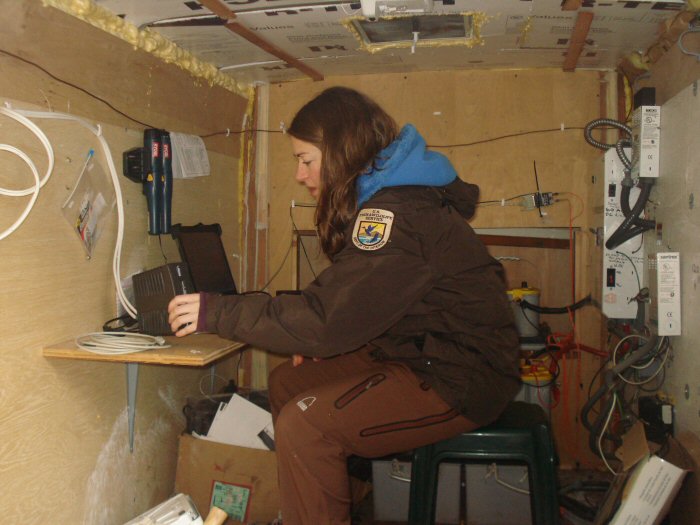
As I trudge through about 6 inches of fresh snow in the dark I wonder what the day holds. Most college students are still in their beds at their homes or some tropical place, but not me. I am awake before the sun, before most people in our town. Not because I don’t want to be in my warm bed but because I have fish to set free. I am one of seven STEP students hired by the CRFPO biologists to sample the screwtrap in the lower Walla Walla River with the hopes of catching bull trout to tag so we can monitor their movements out into the Columbia River.


After a few blocks the sun starts to peak over the horizon and I reach the science building at Walla Walla University and head down to the basement hoping that the waders and boots are dry and don’t smell too bad. Carrying my equipment I head out to a snow covered vehicle. After a few minutes of getting a ton of snow off the windows and using the defroster, I discover that I may not be adequately dressed for the weather. Our normal thirty minute drive now takes about forty minutes in four wheel drive on a snow covered road with other drivers who seem to have never seen snow in their lives.

Once on site and dressed in river appropriate gear, that was not dry and is quite rank, my partner and I encounter the ice laced winds that are sweeping across the RV park where the fish trap is located. Stomping through the snow in my boots seems to be difficult as the snow and mud stick to the metal on the bottom of the boots, eventually making me about 4 inches taller. Balancing on these new stilts is nothing compared to attempting to open the first of four frozen locks with my now frozen fingers.


Carrying the rest of our equipment to the river on the short trail seems magical with the fresh snow covering the bushes that line the trail, yet I still stumble on my stilts in unseen holes. We reach the river, its banks lined with ice, the trap spinning perfectly with water splashing to add to the icicles dripping from all parts of the cold metal of the trap. One of us cranks in the trap while the other preps the data sheet and buckets. The trap reaches the shore and we grab our equipment. We hope for two things as we enter the water: not to trip and get soaked, and for our waders to not have any holes in them. Fishing out sticks and debris seems to be the hardest as our fingers’ numbness tells us to save what movement we have left and not yet get our hands wet. The night before has produced so many fish that the water in the trap appears cloudy. To our amazement the catch turns out to be more than 200 fish. Identification starts with us immersing our hands in the ice cold water that is 2 degrees Celsius. After sampling the fish our fingers have turned blue. We must now push out the trap since flows have decreased with the cold temperature, and yes it takes both my partner and I to do it making me aware of muscles I did not know I had. Eventually we get back to the rig, we crank up the heat, get out of our wet clothes, and smack the snow off the bottom of our wading boots. Then we sit and thaw out before we head home to rest before turn around and do it all again that evening.
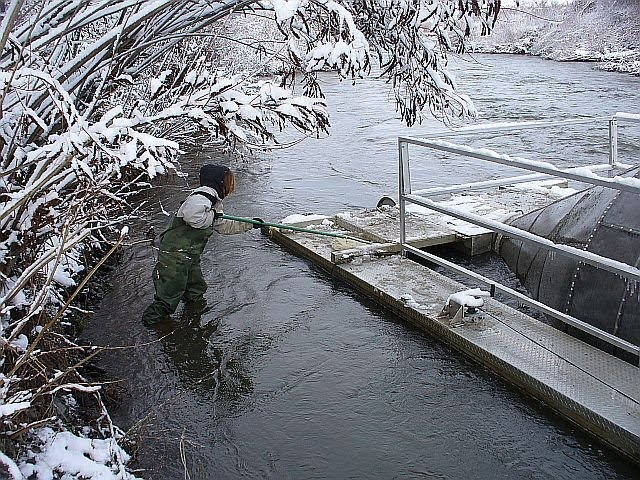

Over time our group developed a perfect system of working together for efficiency and we also discovered the perfect amount of clothing layers to wear- usually about 6or 7. We discovered the great benefit of thick snow gloves and our hands and bodies eventually became use to the cold and the water no longer phases us. The people working the fish trap have been brought together as a team and the experience has allowed me to see the beauty in the river and the many different species of fish that few people get to see in the cold winter months. It is more than just counting fish and recording data. It is working hard for a better future with the people here today and having fun while doing it.

Submitted by Rebecca Bullard

Monday, February 7, 2011

USFWS Presents Its “Mitchell Act Message” at the First Annual Mitchell Act Program Review Meeting


A number of Columbia River Fisheries Program Office staff attended and participated in a two-day conference at the Portland Double Tree Hotel on January 18 and 19, 2011 to highlight the efforts of the USFWS in conducting its Mitchell Act funded programs. The Mitchell Act was initiated in 1938 and is administered by the National Marine Fisheries Service (NMFS) to provide fishery mitigation for Columbia River Basin development, especially hydro-system development, and to help conserve Columbia River salmon and steelhead resources. The Mitchell Act program provides funding in three major program areas: hatchery operations; fish screens and fish ways; and monitoring and evaluation (M&E) and hatchery reform. The funding, although administered by NMFS, is distributed to Washington Department of Fish and Wildlife, Oregon Department of Fish and Wildlife, Idaho Department of Fish and Game, the Yakama Nation, the Nez Perce Tribe, and the USFWS to implement program actions.

The two-day conference on January 18 and 19 was billed as the first annual meeting program review, at least first in recent history, to provide Mitchell Act operators the opportunity to highlight their programs and explain how the Mitchell Act funding they receive is being used to address the goals and objectives of the program. The conference was attended by 80 - 100 agency and tribal staff representatives and presenters and by interested public. NMFS hosted the conference and indicated their desire to make this an annual event for the future that can be used to help set and reshape program direction and help give guidance for future funding decisions for the Mitchell Act program.


A common theme by all agency and tribal representatives that gave presentations was that the Mitchell Act program is a very important program that provides substantial fishing opportunity and fishery benefits to the Pacific Northwest region, as well as fish conservation benefits in the Columbia River Basin. However, there was broad recognition that limited funding has definitely strained the ability of the program to continue to provide these critical benefits. Flat funding since the mid-1990s, reduced buying power for current funding, escalating costs for current program activities, and a whole new set of Endangered Species Act (ESA) driven fishery and hatchery management constraints and costs have definitely taken their toll on program implementation. Program operators have responded by cutting and/or reducing Mitchell Act hatchery production programs in some instances, seeking alternate and/or cost share funding, and prioritizing activities that are most critical to program implementation and program results.

The USFWS made five presentations on the second day of the conference that highlighted its Mitchell Act programs and allowed the Service to “tell its Mitchell Act story”. These five presentations included 1) a general but comprehensive overview of its Mitchell Act hatchery production program, baseline M&E program, fish health program, Abernathy Fish Technology Center (AFTC) program, and newly expanded M&E and hatchery reform program, 2) a focused fish marking, tagging, and bio-sampling program presentation, 3) a focused fish health program presentation, 4) a presentation on recent Eagle Creek winter steelhead and coho ecological interaction studies, and 5) a presentation on recent Gorge area fall Chinook investigations and pre-Condit Dam removal activities in the Big White salmon River. All of these presentations were applauded for their high quality and vivid demonstration of the critical benefits that these USFWS Mitchell Act production programs and M&E programs bring to the Pacific Northwest region for sustainable fisheries and fish conservation.


The USFWS acknowledges the critical nature of the Mitchell Act production program to meeting tribal trust responsibilities; honoring the current 2008-2017 U.S. v. Oregon Management Agreement; meeting Pacific Salmon Treaty production expectations; and meeting other social, economic, and cultural needs and thus has done all that it can within overall budget constraints to maintain these important programs. The USFWS has also been very proactive to implement a number of fish conservation and hatchery reform actions and to expand its M&E programs for its Mitchell Act funded facilities as recommended by recent Hatchery and Scientific Review Group (HSRG) and Hatchery Review Team (HRT) reviews. The challenge is to manage our programs in such a way that they continue to provide the fishery benefits anticipated under the original purpose of the Mitchell Act program while also addressing other biological and legal management constraints on our management actions such as ESA compliance and implementation of hatchery biological opinion terms and conditions.

The USFWS is very proud of its Mitchell Act program efforts and believes its program can best be described as: Quality Stewardship Mitigation for the 21st Century. The USFWS continues to work together with its Columbia River co-manager partners to improve the overall Mitchell Act program and thereby provide the benefits anticipated and honor its promise to the Columbia River Tribes and the American public for continued harvest opportunity, even in the midst of very significant funding and ESA listing and recovery challenges. All of the USFWS powerpoint presentations and those by other agency and tribal presenters will soon be available for viewing at the NMFS webpage for their Mitchell Act program: http://www.nwr.noaa.gov/Salmon-Harvest-Hatcheries/Hatcheries/MA-prgrm.cfm which is currently being restructured. Readers are encouraged to link to this webpage for further information on the Mitchell Act program and its benefits to the Pacific Northwest region.

Submitted by: Tim W. Roth

Tuesday, January 25, 2011

Hiking Along the SF Walla Walla River

Antennas displaced by high flows
We left before dawn on Wednesday morning. After a nearly 4 hour drive, we arrived at the first PIT tag antenna site. The first thing we saw, were a couple of the antennas tied up close to the bank. High flows had occurred throughout the state that past weekend, causing damage and flooding in many areas. The antennas appeared undamaged but were definitely out of place. Courtney quickly loaded updates to the computer and downloaded the PIT tag information onto her thumbdrive. We did this throughout the day, one site to the next. That was the easy day.
Trailhead
After a night in the hotel, we rose once again before dawn, packed up our gear, and headed out to visit a remote site located along the SF Walla Walla River. We knew the hike in was about 4 miles but we didn’t know how much snow or ice would be covering the trail. It was uncertain whether we could even make it to the site safely. There was about an inch of snow at the trailhead, so we donned layers of clothes and loaded up our packs with snowshoes, yaktrax for icy conditions, and an ice axe, in addition to the essentials needed to maintain the site as well as plenty of snacks. George, the gentleman who helps us maintain this site, estimated that it would take a good 2½ to 3 hours to get to our destination.


About 15 minutes into the hike, we soon figured that we would probably not need the snow shoes so we hid them behind some trees, hoping that we were right in our assumption. The trail had patches of ice and snow and was bare under some of the trees. Soon we decided the ice axe could stay behind as well.

Onward we went. The first neat thing we saw were some tracks. Not just any tracks though. These appeared to be Big Dog tracks or wolf. Seeing that there were no human prints around, we think they were wolf tracks. Wolf have been spotted just 70 miles from where we were so it was not too far fetched to believe that these were indeed the tracks of wolves. That was exciting for me. We followed the tracks for some time and I was happy that we were following the animal who was making the tracks and not the other way around.


At one point, we detected a rancid, decaying odor. As it got stronger, we looked off the trail towards the river and saw an elk carcass covered with tree limbs and twigs. It couldn’t have been more than 10 meters off the trail. Could this animal have been cached by a cougar? We did not have the answer to that but we were a bit spooked and hurried on our way.

The only live animals we saw were a grouse which we flushed out of some trees and the elk and deer feeding on the steep hills above the canyon. At one point, I caught a glimpse of a brownish mammal scurrying into the trees above the trail. It could have been a rabbit I suppose.


The hike up to the site was gorgeous with the snow covered trees and hillsides and river down below. We arrived at the site and once again, Courtney did her thing. I was very impressed with the equipment running this site. A small trailer housed the PIT tag detector, batteries, and computer and whatever other electronics are needed. Solar panels were perched over the trailer along with a small satellite dish. There were also more than half of a dozen big propane tanks alongside the trailer. Wow!

I later learned that the solar panels will charge the batteries in sunny weather. In the event that they are not working, either in the winter months or extended periods of cloudy days, the propane automatically gets kicked on to take over the charging process. The batteries keep the PIT tag detector and computer running. Data is uploaded via the satellite dish at times. All of this high technology in the middle of nowhere!

After taking a few pictures, downloading data, we shut the site down since those antennas were destroyed with the high flows. We loaded up our gear and headed back down the trail.


We pushed on down the trail since we still had more sites to visit that day. We once again rushed by the site of the elk kill. I for one, did not want to be around if something came back to get a snack. When we reached the snowy part of the trail where we originally saw the wolf tracks, there were some new tracks. A few big cat tracks crossed the trail. Most likely a cougar. Further down the trail we saw smaller cat tracks, maybe those of a bobcat. In addition, there were raccoon and rabbit tracks. All very cool, indeed.

All in all, it was a very good day. Nearly 4 hours of steady hiking, beautiful scenery, and great company. I’d love to do it again.

For more information about this great project, click here.

Submitted by Donna Allard

Thursday, January 13, 2011

How Computers Help Us to Understand Mark Selective Fishing

Mark selective fishing is a strategy to protect endangered wild salmon and steelhead while allowing fishers to harvest abundant hatchery fish. The idea is to release unmarked wild fish and keep only hatchery fish marked with an adipose fin clip. Releasing unmarked wild fish is an easy concept to understand but estimating the impacts to the unmarked fish is a lot more complicated. There are infinite combinations of unmarked to marked ratios, size of mark selective fishery relative to non-selective fishery, and harvest rates, all of which affect the outcomes.

For problems that are too complicated to solve with a pencil and paper, we turn to computer models, just like forecasting the weather or the stock market, designing airplanes and bridges, you name it. For “what if” type of questions, a common technique is called Monte Carlo simulation because probabilities to a computer are not much different than a person throwing a dice. For our mark-selective fishing question, we add another technique where we track the fate of each and every fish in the fishery, all two hundred and fifty thousand of them.

Tell the computer to pick a fish at random. Is it marked or unmarked? Pick a fishery at random. If the fishery is non-selective, then flag the fish as caught. If the fishery is mark selective and the fish is marked, then flag the fish as caught. But if the fish is unmarked, then add one to the number of times the fish has been released. Not all fish survive being released because survival depends on where they were hooked and how they were handled. Pick another random number. If it is better than the odds, then the fish is still alive to be caught again. Otherwise, flag the fish as dead. Pick another fish at random until the catch quota has been achieved and add up the number of dead unmarked fish.

You have to repeat the procedure many times, until the average of all trials is stable. The result is an example of how we use computers to help us understand complex problems that are difficult to observe in the field or, in this case, under water.

Submitted by Henry Yuen

Thursday, December 23, 2010

Highlights from this past year!

It's that time of the year. Report writing. So we all needed a break from that and thought we’d take the opportunity to share with you some of our highlights from this past year.

Donna was lucky enough to see Western Pearlshell mussels releasing conglutinates.


Jen recently published her first manuscript in River Research and Applications which describes how Bonneville Dam tailwater elevation and seasonal precipitation influence chum salmon spawning activities in tributaries below Bonneville Dam.

Rod shared this: "While I was doing redd surveys this year on the White Salmon River in Washington, I saw what I thought was the biggest tule fall Chinook salmon I've ever seen spawning there. She was deep in a pool and I could only make out her tail, which was white from digging a redd in cobble to put her eggs in. It was a massive tail and I saw the tail dig sideways in the gravel, and could roughly make out her dark silhouette when she was sideways. Several fish attempted to swim into her area of that deep pool and then would bolt away as she chased them off. Easily the highlight of my year."

TAW had 5 highlights including:
-larval pacific lamprey surviving in saline conditions
-observing western pearlshell mussel conglutinates around the fifth of may
-bull trout critical habitat designation being completed
-coauthoring a manuscript that showed how regulating tailwater elevation at Bonneville dam influences chum salmon spawning in tributaries and
-getting a PIT tag antenna in NE Oregon to operate exclusively on solar energy.

Paul got this screw trap out of a NE Oregon stream unscathed:


Don and his crew completed the final report for 5 years worth of research to determine whether Bull Trout from the Walla Walla Basin venture out into the mainstem Columbia River. They do.

Shawna learned how to surgically implant radio tags in bull trout using electronarcosis:


Jeff investigated the salinity tolerance of Pacific lamprey ammocoetes.

Christina completed a first draft of the Pacific Lamprey conservation plan.

Ruby went to see Condit Dam,scheduled to be removed next year, with Howard and his daughter.


Mari's highlight of the year was enjoying the camaraderie at the office retreat.

Maureen PIT tagged a total of 3000 juvenile wild steelhead in Eagle and North Fork Eagle Creeks.

Courtney's highlights included:
- tagging mussels with Donna on a warm summers day
- hiking up the SF Walla Walla River trail to the Bear Creek PIT site and watching rattlesnakes scurry as they got closer, and
- jet boating up the lower Walla Walla River.
In that order.


Henry completed a simulation for Pacific Fishery Management Council that showed that fishing both mark-selective and non-selective fisheries in the same time period and management area would result in an underestimation of unmarked impacts in the non-selective fishery.

In seach of bull trout and deploying temperature loggers Brook, Shawna, and Nichole left the town of Imnaha and ventured 24 miles on a gravel road and stumbled across Hat Point, the high point on the Oregon rim of Hell’s Canyon with the best view of of Hell’s Canyon and the Seven Devils in Eastern Oregon.


David coordinated with other offices and completed the mapping portion of the 2010 Bull Trout Final Critical Habitat.

Trevor will always have fond memories of E-fishing winter steelhead in Eagle creek with Bill, Brian, Sheila, Maureen and the crew for all the double rainbows, sick sticks, trucker talk, big fish screams, laughter, and good times.


In 2010, Marci was able to be a part of moving a bull trout recovery action forward in helping to develop the Clackamas bull trout reintroduction program. Oh - and she also got to get her boots wet occasionally by helping out with Pacific lamprey, coho and coastal cutthroat trout surveys. She simultaneously managed to 1) avoid full body stream immersion, and 2) not get eaten by the insanely large spiders that dominated the forest insect fauna this year. Yahoo!!!

Larry’s highlight was finally getting all of the fish back from the taxidermist and up on the walls.

Bill really enjoyed working with students on Eagle Creek.

Amy's programs helped remove 19 barriers to upstream salmon movements, improved over 14 miles of instream and riparian habitats, and restored 80 acres of tidal wetland. 2010 was a great year in restoration for Oregon's north coast.

I hope you all enjoyed our highlights. 2010 was a great year at the CRFPO! With that, I bid you farewell until next year. Merry Christmas and Happy New Year!

Thursday, December 16, 2010

Four Years at the CRFPO


It all started about four years ago when I first found myself standing in waist deep water inside a cold and dark room. As I checked my surroundings, my senses were overwhelmed by the thick, damp, and cool air. The strong smell of heavy moss that characterizes many streams in the Pacific Northwest filled my nostrils with every breath. This room had the feel of a place that people rarely entered, and those that did come here, didn’t stay for long.


Prior to my entrance, the water in the room was still, now it rippled and boiled, for my presence had stirred many beasts under the surface. The powerful animals were becoming nervous, and they began to express their will to survive regardless of my intentions. Echoing sound waves from nearby rapids pulsated off the concrete walls and continuously reminded me that I was way out of my element. I struggled for balance on the slick flooring nervously looking up at my coworkers above to ensure I hadn’t been abandoned. I continued on and apprehensively scooted my feet towards the grey ghostly shapes as they had now congregated in numbers near the corner of the room. My mind subconsciously flashed to a Star Wars scene where Luke Skywalker and Han Solo were faced with a mysterious aquatic animal (a hungry dianoga) in the waters of the Death Star’s trash compactor. As I closed the distance on the group, they grew increasingly nervous probably realizing I had no intent of halting my forward progress. My anticipation grew as I knew with just one more step I would be within netting range, and prove my merit to my coworkers watching from above. Just as I was visualizing how I would expertly step and swipe up my prey like a hungry osprey, the group broke ranks like NFL linebackers and burst from their huddle in a violent tail walk assault across the surface of the water towards me with speeds that seemed to approach time travel. Instantly drenched with water and defeat, I made a defensive and empty swipe in a convulsive manner that had very little in resemblance to a raptor’s successful quest for prey.


My attempt at self-protection also failed as a heavy-shouldered 15 pound Eagle Creek steelhead had just rammed into my leg knocking me off balance and nearly upending me. With a bruised shin and ego, I regained my balance, smiled, and absorbed the echoing laughter that bounced off the ladder walls as my coworkers above expressed copious amounts of joy in knowing the new guy had just been beat into the gang. Steelhead 1, Trevor 0, and that is how the score began as I awkwardly wandered around the fish ladder proceeding to help capture, bio-sample, tag, and release every one of the dozen adult steelhead remaining in the trap. I knew from that day on that this new job as a Fish Biologist with the Columbia River Fisheries Program Office was going to be challenging, exciting, rewarding, and right up my alley.


Fast forward four years after my first field day, and I am now packing up my office and taking my experiences with me as I began a new permanent job with NOAA Fisheries hydropower division. Looking back after four years, I realize that I have become comfortable inside fish ladders, hatchery raceways, and streams while working on countless projects doing things that I could previously only dream of. The projects I have worked on at this office have not only been fun and exciting, but more importantly I feel they helped contribute to the continued benefit of both fish and fisheries.

Whether I was sliding around in murky fish ladders, capturing and tagging fish, building PIT tag antennas, writing reports, or conducting numerous other tasks, I gained skills at this office that will no doubt be invaluable as I continue on my career path. There is now doubt in my mind that many aspects of working here will be missed. However, what I will miss the most as I leave this office isn’t the excitement of the field work or the rewarding challenges, it won’t be the roomy office with a door and the short commute, it won’t even be the slimy fish hands and numb fingers. What I will miss the most without a doubt will be the friends and coworkers who have shared this experience with me and contributed so much to the comradery that make this office a truly great place to work.

So with that I will pack up my gear and take a turn down the road of life, and hopefully bump into you all in future travels. Thank you all for the wonderful experience and I hope you all the best.


Submitted by Trevor Conder

Thursday, December 2, 2010

Northeast Oregon in Winter


We are traveling to the Wallowa National Forest to maintain our PIT tag antennas. This requires a visit to our site, make sure the power is running, and download our information. PIT tags were implanted in bulltrout in the summer months to gain an understanding of their abundance and distribution. When they swim past our antennas, their unique code is recorded with a date and time stamp. This information gives us an understanding of their movements throughout the year.


Sometimes it is very cold but it is always beautiful. Last December I recorded a temperature of -11ºF! We use MAX to drive to our remote sites and snowshoe in the rest of the way. Snow is on the ground from November to June and has been as deep as 6 feet at times! Under all that snow and ice, bulltrout are there waiting for the thaw.

Submitted by Brook Silver