Showing posts with label Lower Columbia River fall Chinook Salmon. Show all posts

Monday, September 20, 2010

A Visit to the Gorge


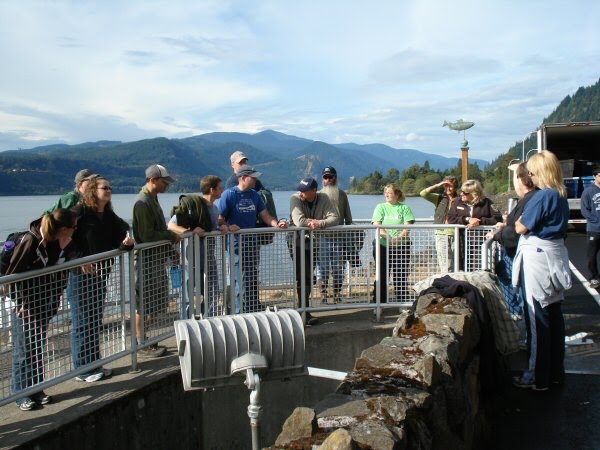
Last Friday, Amy, the educator for Columbia Springs, and I held the 3rd annual fish workshop called Healthy Water Habitats and Hatchery Tour. We met 12 teachers at Columbia Springs and carpooled up to Spring Creek National Fish Hatchery (NFH) where spawning activities were in full swing. We left a rainy Vancouver and arrived at the hatchery to find a warm, sunny day. After a brief introduction to the PIT (passive integrated transponder) tag detector station and a short visit to the fish ladder, the teachers suited up into raingear and had the chance to spawn some of the Tule fall chinook salmon. They got a first hand, up close look at the bustling activities that take place this time each fall. In addition to spawning activities, excess fish were being loaded into totes in preparation for a trip to the food bank.


Just before lunch, we headed up to Carson NFH. After lunch, I gave a short presentation on an education trunk I developed last year called "The Columbia River" trunk. It highlights some of my favorite species including coastal cutthroat trout, Pacific lamprey, and Western Pearlshell mussels. A last section raises awareness to the threats of aquatic nuisance species.


We reviewed some of the activities in the trunk and 'played' a short activity called "Water address". This activity allows students to identify plants and animals and their habitats by analyzing clues that describe water-related adaptations of aquatic and terrestrial organisms. At this point we were running out of time but not before we learned more about Carson NFH from the assistant manager, Thomas.All in all, the day was great, the teachers were an exceptional bunch, and the rain held off until the end of the day. Can't ask for more than that.


Posted by Donna Allard

Tuesday, June 1, 2010

Preparing for Removal of Condit Dam

Dam removal is as controversial as ever in the Pacific Northwest and, from my experience, has a myriad of fish restoration factors to consider much less all the other addditonal considerations that go into the decision to remove a dam. Biologists in our office have done assessments that are trying to either enumerate or document the presence or absence of species in areas both upstream and downstream of Condit Dam. These assessments will provide the pre-removal "snapshot" of White Salmon River fish populations and, hopefully with additional assessments and monitoring in the years after the removal, there will be a story of the repopulation of both anadromous and resident fish species into newly available habitat.

For the past two years, I worked with several other U.S. Fish and Wildlfie Service biologists, Spring Creek National Fish Hatchery staff, PacifiCorp (owner and operator of Condit Dam), Washington Department of Fish and Wildlife, National Marine Fisheries Service, Yakama Nation Fisheries, The U.S. Forest Service and the U.S. Geological Survey's Columbia River Research Laboratory on planned capture and transport of Lower Columbia River fall Chinook salmon. The breaching of Condit Dam and draining of Northwestern Lake will temporarily inundate the spawning habitat of fall Chinook salmon with sediment in the lower White Salmon River. This will in turn affect the survival of the salmon eggs placed by fall Chinook salmon in the lower White Salmon River (annually in September) immediately prior to the scheduled removal of the dam (currently October 2011). A decision was made by representatives of the previously mentioned agencies, and the operator of the dam, to transport adult fall Chinook salmon upstream of Condit Dam and allow them to spawn naturally in an area of the river that will be unaffected by sediment released from removal of Condit Dam. This decision was informed by other assessments and data collection of fall Chinook salmon spawning abundance, genetics, and juvenile production in the lower White Salmon River.

The following videos show some of the work that was performed during 2008 and 2009 assessments. In 2008, we assessed three different capture mentods in an effort to catch and transport Lower Columbia River fall Chinook salmon upstream of Condit Dam to document how successful our proposed actions might be. In 2009, we assessed the use of a resistance board weir in combination with a dormant adult salmon collection facility and a Video Passage System (VPS). Here are the links to the 2008 report and the 2009 report to view them in their entirety. Aspects of these efforts are ongoing in 2010.


Submitted by Rod Engle.