Tuesday, November 22, 2011

The Quest For Fat

Lipids are generically known as fat. They are the main energy reserve in animals and critical to the survival, fitness, reproduction, and recruitment of fish. Since the ultimate goal of an animal is to reproduce and pass its genes onto future generations, the rest can be considered details. Lipids are the underlying fuel that all organisms use to this end. Lipids pack a large energetic punch - a large amount of calories are stored in a small amount of space. In many animals like fish lipids can broadly be considered the storage fuel needed for significant energetically costly events – the afterburner if you will. A bear needs to amass a large amount of fat – which will be slowly converted to energy throughout the winter. Similarly, a salmon needs to build up a surplus lipid reserves if it is to successfully migrate hundreds of miles without feeding, attract a mate, convert some of its energy into gametes, and spawn.


Figure 1. A lipid molecule.

Lampreys are unique in that they undergo metamorphosis. Pacific lamprey transform from larvae to juveniles, which outmigrate to the ocean, parasitically feed on other fishes, and return to freshwater as adults to spawn. Western brook lamprey transform directly from larvae to adults – which will never feed again – and spawn and die. The process of metamorphosis itself is energetically costly. Internal organs rearrange and change, external anatomy changes too. This takes energy. Larval lampreys gain their nutrition (and ultimately lipids) through filter feeding detritus. Furthermore, lampreys don’t feed during transformation; Pacific lamprey will resume feeding once transformed as they approach or enter the ocean and western brook lamprey will never feed again! In theory, one should see a buildup of lipids just prior to metamorphosis – and this should be measurable. It is plausible that western brook lamprey may need even more lipids – as they will never feed again and acquire new energy.


Figure 2. Different lifestages of lamprey.

We have been evaluating lipid extraction techniques and lipid dynamics in larval Pacific lamprey and western brook lamprey. Unfortunately the lipid extraction procedure is lethal. The larval lamprey are euthanized and then homogenized into a paste. A mixture of chloroform and methanol is used to extract the lipids. A characteristic of lipids is that they are not soluble in water (this is why fat globules float on water) but they are in other similar organic solvents (e.g., chloroform, ether, acetone). Once the lipids are extracted they are weighed and expressed as a percentage of the entire body weight.


Figure 3. Solution with extracted lipids.

Knowledge of lipid content can also give a measurement of “condition” or well-being of a fish. In the fish world, the fatter the fish is usually considered healthier. Lampreys with higher lipid content would be considered healthier. We also measure condition with non-lethal means by calculating the weight-to-length ratio of the fish. In addition, we are investigating a technique for measuring body density. We use hydrostatic weighing, which is essentially weighing a fish in water, calculating the amount of water displaced, thereby calculating density. We are comparing these different measures to see if they are related and if so, we may be able to use a nonlethal technique to measure condition in lamprey.


Figure 4. Weighing a larval lamprey in water to calculate body density.

So far we haven’t been able to detect a strong pattern of correlation among the different techniques to measure condition. We have noticed that small and large western brook lamprey have higher lipid content than do similar sized Pacific lamprey. This would support the notion that western brook lamprey need to have more lipids in preparation for metamorphosis. These lampreys were collected in the fall, presumably after the time that any larvae that were going to transform would have done so. Essentially we examined larvae that were not likely to transform that year. We are going to examine lipids from another group of lamprey that were collected in the summer. Some of these individuals should be ready to transform and we might be able to see more clear relationships of lipid content.


Figure 5. Lipid content in larval Pacific lamprey and western brook lamprey.

Submitted by Jeff Jolley

Thursday, November 17, 2011

Learning in the Great Outdoors


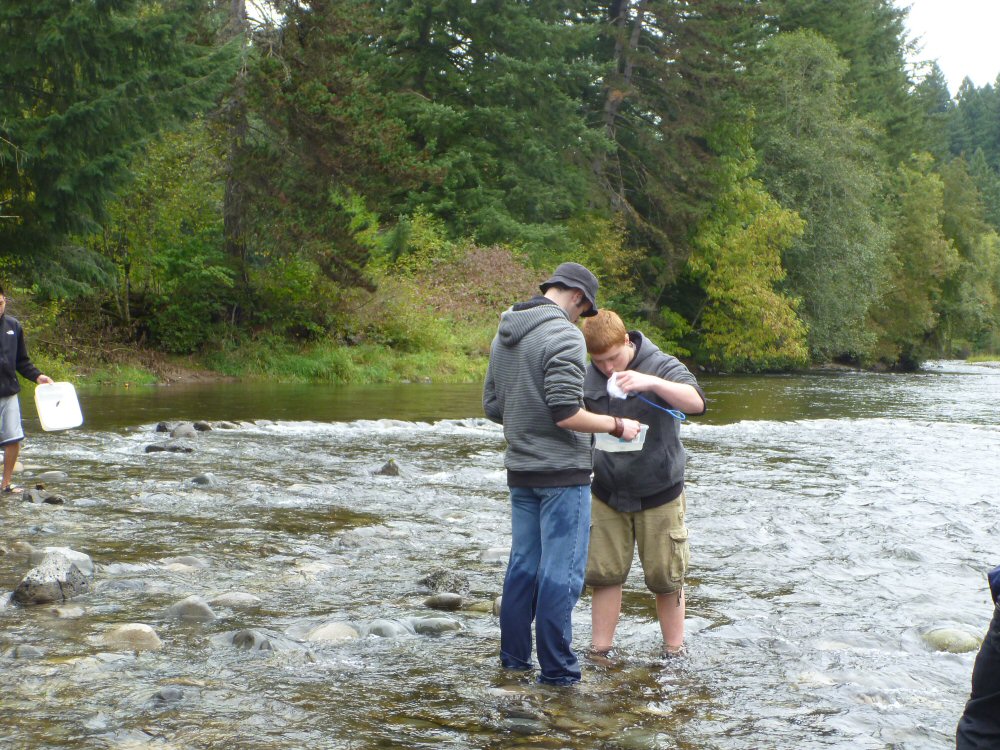
This fall, I accompanied the Heritage High School AP Biology students on their first field trip of the year. We met at Lewisville Park and after a brief introduction to the day’s activities, we picked up our gear and headed down to the river to collect and study the macroinvertebrates. The students had studied the insects in advance and came prepared with notebook in hand.


Although the water was cool, students who didn’t have boots just took off their shoes and went into the water barefoot. A bit too chilly for me. They collected lots of insects and took them back to the bank for study. Some students drew a picture of their insects and some read all about them. They recorded everything in their notebooks. It was great seeing the kids having fun and learning at the same time. And because most high school students can get instruction and work independently, I got to study the insects alongside them.


Aside from insect identification, the students did some water testing and hiking. As an added bonus, Chinook were spawning in the river. So, excellent weather, excellent students, and salmon made for a great day out in the field.

Submitted by Donna Allard

Tuesday, November 8, 2011

Catch some baked salmon rolls!

I am more than just an employee who asks for receipts and cost accounting codes. I love to cook and bake and many of my coworkers have sampled my baking endeavors. Please try this recipe that went over especially well with the fish biologists at our office!

BAKED SALMON ROLLS:
Sweet and savory, with a taste of the orient, aimed to please a lot of appetites.
Makes 16 – 4 inch rolls

Ingredients

FILLING

12 ounces boneless and skinless salmon

1 Tablespoon dried minced onion

1 Tablespoon hoisin sauce

1 Tablespoon seafood cocktail sauce

1/4 teaspoon garlic powder

1/8 teaspoon Chinese five spice

1/4 cup mayonnaise

1 Tablespoon lemon juice

Directions

Combine all ingredients till well mixed.


DOUGH

2 packages active dry yeast

3/4 cup warm milk (120◦)

1/3 cup sugar

1/4 cup melted butter

1 teaspoon salt

2 eggs, room temperature

3 ½ cups all-purpose flour

2 Tablespoons milk

1 ounce of sesame seeds (optional)
16 pieces 3x3 inch waxed paper

Directions

Combine 1 ½ cups of the flour and the yeast in a bowl.

Heat and stir milk, sugar, butter, and salt until warm (120◦). Add to flour/yeast mixture with eggs. Beat with an electric mixer on low speed for a minute till all ingredients are mixed into a thick batter. Beat on high speed for a few minutes till mixture is smooth.

Gradually mix in the rest of the flour in with a spoon to make dough firm. Turn out onto a lightly floured surface and knead until smooth and workable (about 5 minutes).

Place dough in a greased bowl, turn dough over to grease surface, and cover and allow dough to rise in a warm place until doubled in bulk (1 to 1 ½ hours).

Punch down dough, and turn out onto a lightly floured surface. Allow dough to rest 2 minutes before cutting into 16 equal pieces.

Roll out each piece into a ball, and then roll into a 4 inch circle, dusting with flour if necessary. Place 1 heaping tablespoon of filing in center of dough.

Pull dough over filling and close top by crimping and pinching edges together.

Place roll on piece of waxed paper, folded edge down. Space rolls 2 inches apart on a cookie sheet. Allow to rise 30 to 45 minutes in a warm oven (95◦F).

Brush gently with milk and sprinkle with sesame seeds. Bake at 350◦F for 15 minutes or until golden brown.

Enjoy!!!

--Submitted by Valerie Sinesky, Budget Tech at Columbia River Fisheries Program Office

Monday, October 31, 2011

Another Great Day Outside


Slightly ahead of the group, Annie and I walked up Post Road, catching the numerous crickets as we went. She suddenly turned to me and said "It's sort of funny when you look around at people. Everyone has a cellphone or iPod or something to occupy themselves with when all they really need to do is go outside!" Well, that was a great end to a week. Annie is in 5th grade, or 4th, I can't remember. I just know she had a fantastic day.

We had just spent the day at Hopkins Demonstration Forest in Oregon City. Our group went down to the creek to explore, catch aquatic insects and test the water. Along the way, we had the students lead with a map in hand. The group was divided between going the long way and 'off-road' or staying on the trail and going directly to our tub filled with the supplies we would need. Annie of course wanted to go directly to the tub and get started.


The group compromised and got to the tub soon. Off came the shoes, on went the boots. Into the water the kids went after a bit of instruction. They were filled with energy and throughout the day, Annie would stop, look up, and shout "We are the luckiest group here today. We get to go in the water!"


Wolftree sponsored the trip and had prepared the students earlier this month with a classroom visit. Hopkins Demonstration Forest provided a great place to study aquatics, trees, plants, fungi and lichen, and wildlife.


At the end of the day during the student presentations, we learned the fungi and lichen group had seen cougar tracks and found lots of edible mushrooms including 'The Prince' and chanterelles. Other groups brought back tales of licking banana slugs, counting the rings on a tree core, or finding the 'toilet paper' shrub. Despite the chilly start to the day, the sun came out and the kids left with a bit more knowledge and enthusiasm for being outside.


Submitted by Donna Allard

Thursday, October 20, 2011

Creatures of the Night - 2011

Every year for the past 4 or 5, we have been part of a family event, called Creatures of the Night. This event is hosted by Clark County Environmental Services, Columbia Springs Environmental Education Center, and our office. It is a fun, free event geared towards families. We typically get 30 to 50 people. This year - over 150 kids and parents showed up to participate and learn about these mysterious creatures. Wow!


We started off with the audience, mainly children telling bat jokes, from cards which we handed out. Interspersed with the jokes, some of the older kids and their parents told the audience some interesting bat facts. We then talked about other animals which come out at night, including raccoons, opposums, and beavers. A few short video clips were shown.

A very nice video was played highlighting bats. The audience loved it. Lots of giggles and comments about some of the bats. I have watched this video hundreds of times over, well maybe a bit of an exaggeration, and I still love it, not an exaggeration.

We then brought in a bird specialist to speak about owls. Last year she actually brought in a screech owl named Simon but she no longer has him. Even without the live bird though, her presentation was great and was followed with lots of questions and answers.


This presentation led into what is usually the best part of the evening: owl pellets. The excitement level grew in the room as we told the kids how to dissect their pellet and what to look for. Each child was given a pellet with a picture of a vole skeleton. I can't even begin to tell you how much the kids and parents alike loved this activity.


After everyone gathered their bones, fur, and bone chart into a plastic bag, we headed outdoors to look for bats or anything else which might be lurking. I had not expected many people to stay for the walk, it being a school night, so I was surprised when over 50 people followed me to the overlook. There were lots of questions and lots of wide-eyed children looking up into the sky for any signs of owls or bats. Even though I had my trusty bat detector, there were no bats spotted during the evening. At that point, most families headed back home, but not without giving us plenty of praise and thanks for this wonderful event.

And now I must give thanks to the local cub scout troop, the Tigers, who attended the event and offered us their help in cleaning and organizing the room we used. It would have taken us much longer if not for their much appreciated help.

Each time we hold this event, it gets better. With the amazing response we got this year, we may even consider holding more than one of these events in the future. Who knows?

To read more, here is a great article and pictures from the evening courtesy of the Columbian newspaper.

Submitted by Donna Allard

Monday, October 17, 2011

Late Summer Work at Sheldon and Hart Mountain National Wildlife Refuges

The summer started a little late for Cory and I, as we didn’t get down to Sheldon National Wildlife Refuge in Nevada until the first week of August. After a week of getting oriented with the protocol and the refuge, we were sent out on our own for the duration of our employment. In the middle of our tour of duty we also spent a few weeks in Hart Mountain National Antelope Refuge in southern Oregon. In Sheldon we sampled Virgin and Fish Creek watershed and in Hart Mountain we Sampled the Guano Creek watershed. We drove a lot of very rocky and bumpy roads, hiked many miles with heavy packs, and found many more dry and unsampleable sites than sampleable ones. We even had a stream that was sampleable in its mid reaches but dry in its upper reaches and dried up before its deposit into the nearest reservoir. We got used to trudging through roses, stinging nettles, and sagebrush that were very thick and as tall as we were. There were also many beautiful sunsets and sunrises as well as brilliantly clear starry skies. We soaked in the hot-spring pool at Virgin Campground with guppies, bullfrog tadpoles, and opal miners.


Cory shocking up fish in Fish Creek


Sometimes there was water upstream from standing at one point in the creek…


…but the creek was dry downstream (Fish Creek)


Horse pelvic girdles make great masks.


We saw lots of horse-damaged streams in Sheldon.


One of the many gorgeous sunsets. This one was at Hart Mountain.


Virgin Canyon


An army gravesite at Hart Mountain.


We sampled fish that looked more like cutthroat and fish that looked like redbands, and every hybrid combination you could think of in between. We also sampled a few Alvord chub and a lot of Tui chub in Nevada. Aside from fish, we saw many different kinds of animals. We saw deer, pronghorn antelope, wild horses and burrows, black-tailed jackrabbits, rattlesnakes, coyotes, lizards, thousands of little frogs, lots of different waterfowl species and other birds, and even a pygmy rabbit, which a wildlife crew had been searching for all summer on Sheldon but never saw.


One of the prettier fish we saw in Guano Creek.


Wild horses at Sheldon.


Burros at Sheldon.


Deer at Hart Mountain.


Coyote pup at Sheldon


Submitted by Ben Willis and Cory Stratton